Georges Picquart—Alfred Dreyfus
An Officer and a SpyThe relationship between Georges Picquart and Alfred Dreyfus moves from hostility and institutional distance to a reluctant alliance founded on evidence, then ends without easy intimacy. Picquart once taught Dreyfus; after Dreyfus’s conviction, he wants him removed from the country and initially regards his guilt as certain. The discovery that the bordereau points to Charles Ferdinand Walsin Esterhazy forces Picquart to confront the injustice of the verdict and to oppose the military hierarchy that seeks to preserve it. Yet even after Dreyfus is freed and exonerated, their bond remains complicated by silence, competing claims of fairness, and Picquart’s difficulty in accepting gratitude or reopening old conflicts.
From Former Student to Condemned Prisoner
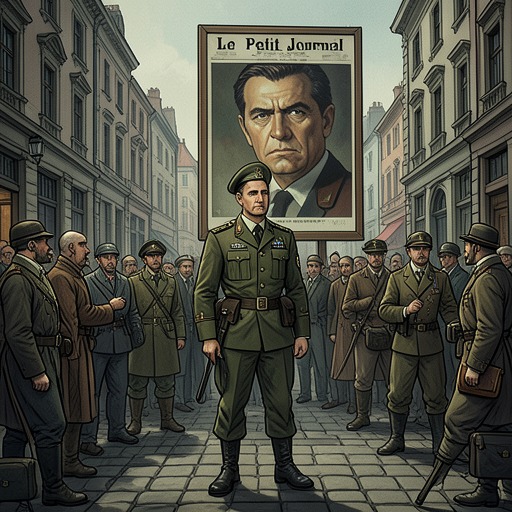
At the ceremony marking Dreyfus’s degradation, Picquart sees his former student under guard in the same building where he had taught him. His response is not sympathy: he says he has nothing to say to Dreyfus, feels nothing for him, and wishes him gone from Paris, France, and Europe. His attention is fixed on carrying out his duties, including checking that the arrangements proceed according to the minister’s instructions. The prisoner’s clothing has been loosened and his sword scored so that it will break; a signal is prepared to have the band drown out any speech. The procedures make the degradation a carefully managed public spectacle, while Picquart’s own language shows how completely he has accepted the verdict and its consequences.
When Dreyfus passes him, however, the encounter acquires a personal force that the ceremony’s machinery cannot contain. Jean Sandherr turns his back in contempt, but Picquart cannot look away. He notices Dreyfus’s pale, puffy face, open black tunic, and the saliva glinting in his hair. Dreyfus keeps marching, and for an instant their gazes meet. Picquart reads fear and a desperate effort at self-command in his former student’s face, and wonders what role Dreyfus believes he played in the ruin. The moment does not yet reverse Picquart’s judgment, but it makes the condemned man more than an object of the ceremony: he is a former pupil looking back at the officer who watches him.
The public’s abuse continues as Dreyfus is led toward the prison wagon. The police line breaks beneath the crowd’s surge; the spectators shout accusations and threats, and Dreyfus turns toward them and raises his arms. Picquart cannot hear what he says. With Dreyfus’s hands cuffed behind his back, the escort puts him into the wagon and drives him away through the crowd. The scene establishes the gulf between the two men: Dreyfus is exposed to public hatred, while Picquart is positioned among the officials overseeing his removal.
Proximity, Surveillance, and the First Doubt
Picquart later recognizes that Dreyfus had lived at 6 avenue du Trocadéro, close to the apartment of Jean Sandherr. The address is familiar from the case files. Picquart reflects that the men may have passed one another in the street while walking to and from the War Ministry, unaware of the closeness between the condemned officer and the man who would become the case’s leading investigator. At a first-floor window, Picquart sees a pale-faced boy and a young woman, perhaps the boy’s mother, watching the uniformed colonel from above before she draws the child away. The encounter supplies no new evidence about Dreyfus, but it places Picquart’s official scrutiny in a domestic setting, among people whose lives the case has already altered.
For a time, Picquart’s attention to Dreyfus is still expressed through surveillance rather than solidarity. Reports from Guénée on the monitoring of Lucie and Mathieu Dreyfus yield nothing. Picquart reads Lucie’s letters to her husband and Dreyfus’s replies, many of which are not delivered. Reports from French Colonial Ministry officials in Cayenne record the prisoner’s isolation and suffering, including an occasion when he says his heart is sick and breaks down weeping. These communications give Picquart sustained access to the consequences of the sentence while keeping him in the role of administrator and watcher.
His first recorded doubt is directed less at the original conviction than at the punishment imposed afterward. He begins to question why the state continues the costly, elaborate confinement of a prisoner who requires several guards on a small island, along with ongoing administration, surveillance, and censorship. The questions remain private as the months pass, and they do not yet amount to a public challenge to Dreyfus’s guilt. But they mark a change in the relationship: Picquart is no longer considering only whether Dreyfus was convicted; he is beginning to question the continuing machinery built around that conviction.
Evidence Turns Duty into Opposition
The decisive change comes when Picquart finds a striking similarity between two of Esterhazy’s letters and the bordereau. He takes the letters to Alphonse Bertillon, who confirms that the handwriting is identical. Picquart then reviews the evidence against Dreyfus and consults the secret file shown to the judges at the court-martial. When he presents the file to Raoul le Mouton de Boisdeffre, the general is surprised that it still exists. Picquart explains that Jean Sandherr retained it rather than dispersing it as ordered, and that Sandherr had told him where it could be found. For Picquart, the file’s survival matters less than the larger conclusion: the handwriting and the evidence connecting Esterhazy to the bordereau make Dreyfus’s innocence unavoidable.
General Gonse nevertheless insists that the case is finished because the court has pronounced its verdict. Picquart warns that the Dreyfus family has not accepted that ending and that the army’s reputation would suffer if it became known that officers recognized the conviction as unsafe and did nothing. Gonse’s response is that the information must not emerge, and he orders Picquart to leave Dreyfus alone. The order turns Picquart’s changed assessment into a direct conflict with his superiors: the question is no longer simply what the evidence indicates, but whether he will act on it when the institution demands silence.
Gonse later casts inaction as a small concession, suggesting that it should not matter to Picquart if a Jewish prisoner remains on Devil’s Island. Picquart answers that it matters because Dreyfus is innocent. He also makes clear that his position is not rooted in personal affection: until recently he believed Dreyfus guilty, and he would find his own life easier if that belief were still possible. The evidence has displaced convenience. Picquart identifies Esterhazy as the traitor, and he tells Hubert-Joseph Henry that it was Esterhazy, not Dreyfus, who wrote the bordereau; Bertillon’s finding, he says, demolishes the central part of the case against Dreyfus.
Testimony and a Distant Recognition
At the Rennes trial, Dreyfus has become so central to Picquart’s life and has changed his destiny so completely that Picquart finds the man himself unexpectedly ordinary: a quiet stranger behind a pince-nez, resembling a retired minor official. The contrast separates the person before him from the immense case Picquart has carried. When asked to recount events, Picquart gives evidence across the whole of one session and most of the next. He presents the petit bleu, Esterhazy, the bordereau, the letters, telegrams, personalities, forgeries, and lies as a field he knows in minute detail. General Staff officers challenge him on particular points; Picquart answers them, watching the judges as he once watched his pupils to see what they understand.
When the court releases him from the witness stand, Picquart thinks he may see Dreyfus give him a brief nod and half-smile of thanks. The gesture is slight and Picquart himself allows that he may have misread it, but it offers a quiet counterpoint to their first gaze at the degradation ceremony. Then, Dreyfus was the condemned former student and Picquart the officer watching his removal. Now Picquart has spoken publicly for the man whose guilt he once accepted. The change is consequential, but the possible nod does not turn their relationship into an easy friendship.
Gratitude, Rank, and the Limits of Reconciliation
More than a year after Dreyfus’s release, Picquart receives a formal letter asking to meet so that Dreyfus can express his gratitude in person. Picquart replies on the back of a visiting card that he will let Dreyfus know when he can see him, then does nothing further. He explains to himself that Dreyfus finds it difficult to say thank you and that he, in turn, finds it difficult to be thanked; avoiding the meeting spares them both what he regards as an awkwardly sentimental encounter. When newspapers accuse him of refusing to meet Dreyfus, the old distance is visible again: Picquart’s service to Dreyfus has not made him comfortable with Dreyfus’s personal gratitude.
Their later meeting as minister and officer brings a more explicit disagreement. Dreyfus argues that his promotion from captain to major does not account for the years he spent wrongly imprisoned on Devil’s Island. Picquart’s promotion from colonel to brigadier general, by contrast, treats his eight years out of the army as if they were active service. Dreyfus calls the difference unfair and asks Picquart to promote him to the rank he believes he should have attained. Picquart refuses, explaining that the motion passed in July, when support for Dreyfus was strongest, and that reopening the controversy in November would be politically impossible. He also says he must work with officers who had been their enemies and cannot tear open the whole dispute again.
Dreyfus answers that Picquart should do it because it is the right thing to do. Picquart still says it cannot be done, and their silence becomes a chasm between them. The refusal complicates any simple account of reconciliation: Picquart acted on Dreyfus’s innocence when the evidence demanded it, but, now in office, he will not make the correction Dreyfus requests. The relationship ends on a more generous exchange. Picquart apologizes for his part in the degradation ceremony; Dreyfus says Picquart has made up for it and acknowledges the achievement of becoming Minister of War. Picquart replies that he would not have attained the post without Dreyfus. Dreyfus rejects the implication that the achievement was simply bestowed through their history together: Picquart attained it because he did his duty. Their final recognition is mutual, but it rests not on intimacy or full agreement; it rests on the duty that first separated Picquart from his former judgment and ultimately made his defense of Dreyfus possible.